
Before you say, “Awww”, let’s just say that this sentence may just be the cutest start to a life of very low lows. Teach impulse-control parents, it’s probably the need of the hour.
Impulsive: good or bad? Personally, I have always thought of it as a ‘good’ thing, kind-of connected to being thrill-seeking and open to new experiences; associated with someone who likes to learn and is not afraid of change. Positive-sounding, right? It’s all perspective. Ask a school teacher.
To her, ‘impulsive’ is the child who starts work without waiting for instructions, the one who shouts out the (wrong) answer before the question is fully asked, the child who rushes into stuff without self-restraint and before perceiving consequence. Oooooh. Not so positive now, is it? And since this is a parenting column as opposed to a travelogue, I’m going to look at this perspective.
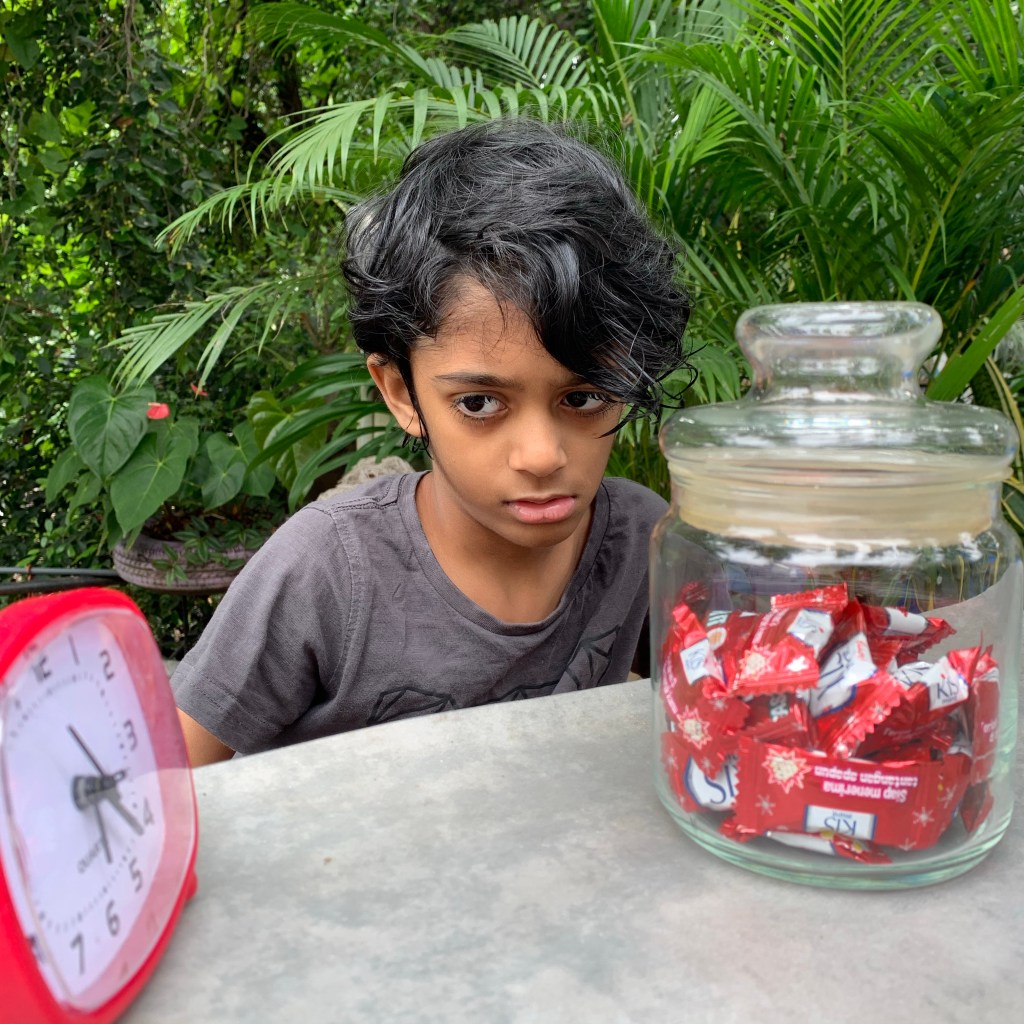
A friend and I talked recently about ‘delayed gratification’ i.e. an indulgence that is not immediate. I read up on it. In simple words, psychologist Walter Mischel conducted a small experiment (read up: Stanford Marshmallow Experiment) placing a small candy each, before kindergarten children and offering them two choices – eat it now or wait 15 minutes and get TWO pieces instead. The experiment ultimately showed that children who were able to hold back from eating immediately, had better “life outcomes” – they did better in school, held higher-paying jobs with more responsibilities, were less likely to have addiction-related issues, etc.
Surely ALL the kids wanted the good stuff. Mischel had more experiments using marshmallows, cookies, pretzels and other “treats”. They didn’t hold back because it wasn’t their favourite. Everything seems to be pointing to better ‘impulse control’. As I read, this began to sink deep; especially because it was explaining some behaviour around the house that often bothers me.
One of my girls, for example, is always excited to, say… go out for a meal. She’s ready in advance and will drive us nuts, urging everyone else to get moving. Then at the restaurant, she’ll order and sulk if her food takes a while coming/if ours arrives before hers. Once she’s enjoyed her meal, she’ll get restless to get home. Her usual question is – ‘What are we doing after this?’ Then she guns for the next activity. I’ve been mistaking this for enthusiasm and impatience, but it may actually be poor impulse control. OMG! What am I gonna do?!
Learn from the children, of course. Mischel’s kids practiced impulse control by distracting themselves; they closed their eyes, tugged at their hair, sang songs, played with toys and avoided looking at the object they desired. How do we adapt that?
Give opportunities for our children to practice waiting. Start as early as possible. Today, I regret not doing more of this sooner, but today is as good a day as any to begin. There’s no reason you HAVE TO attend to kids all the time, every time, immediately. I’m making a specific, ‘parent-knows-best’ statement here, not a general one. Maybe that’s how you teach ‘important’ over ‘urgent’ too.
Play impulse control games. Read up, there are many. ‘Simon Says’ is one such.
Introduce delayed gratification slowly. Tell her about the birthday party that’s coming up this weekend. If she gets dressed and asks to go immediately, you know you have a problem. If she pesters you endlessly, practice distraction techniques. It is a start, but thank God you have the time to practice before something serious hits.
And lead by example, parent. Close the window of that online shopping sale you’re obsessed with. Go distract yourself. You’re never too far away from a good cup of coffee.
This column was first published in the Bangalore Mirror in March 2015
 myuncommonsense